Battery Energy Storage System Building to UL 9540? | Carolina Motion Controls
Published by Carolina Motion Controls, Inc. on 15th Oct 2026
Battery Energy Storage Systems (BESS): Components & UL Control Panels
Battery energy storage is no longer a niche application. Utility-scale storage projects, commercial and industrial BESS installations, and behind-the-meter systems are being specified and built nationwide. The components and UL panel-build requirements for these projects are specific, demanding, and different from conventional industrial automation work. We understand working to make your system meet UL 9540 requires alot of hardwork!
Carolina Motion Controls has been supplying industrial components for over 36 years. We stock the brands that engineers and EPCs specify for BESS (WAGO, Rittal, LAPP, ABB, Pfannenberg, and more). Our UL 508A certified panel shop combines these components into builds for the control panels for a functioning BESS.
If you're sourcing components, specifying a build, or looking for a panel shop experienced with energy storage applications, this page is the right place to start.

What a BESS Installation Actually Needs From a Component and Panel Standpoint
A battery energy storage system is more than batteries. Every installation integrates multiple interconnected electrical and control systems, The battery management system (BMS), power conversion system (PCS), thermal management, grid communications, Surge protection devices, Safety mointoring devices, Cable, busbar, and more. Every one of those components/systems has specific wiring, termination, enclosure, and control requirements.
Here's how our product lines map to what BESS projects actually need:
Enclosures and Thermal Management
Rittal is the dominant specification for BESS enclosures, and for good reason. Outdoor BESS installations, container-based, pad-mounted all require enclosures rated for direct weather exposure, wide temperature swings, and long unattended operation. Rittal's CS Toptec and VX SE enclosures are rated IP 66 and NEMA 4/4X, with double-walled construction and full TS8 frame interiors for maximum component installation flexibility. For scalable modular installations, Rittal's bayable enclosure systems allow multiple cabinets to be joined and expanded without structural redesign.
Rittal & Pfannenberg both handle the thermal side; Cooling units, air/water heat exchangers, and chiller systems that regulate panel or battery temperatures where ambient conditions can be extreme. If batteries are charged and discharged at 45°C, their lifespan is halved compared to use at 20°C. So determining a robust soution for keeping batteries cool is extremely important.
Contact Us for Rittal & Pfrannenberg Solutions →
Wiring, Termination, and Connectivity
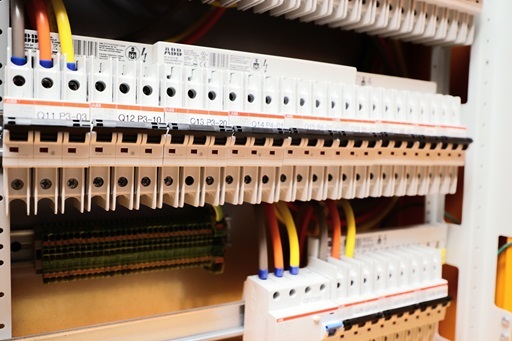
WAGO terminal blocks are utilized throughout BESS control and battery management panels for many electrical connections. CAGE CLAMP spring pressure technology makes maintenance-free, vibration-proof connections that don't loosen over time. In battery storage environments where panels operate unattended for extended periods and connection reliability is a safety requirement, that matters.
For control and signal wiring, WAGO's TOPJOB S rail-mount terminal block family covers various configurations: fused, disconnect, test, diode, and LED monitoring terminals on the same DIN rail. WAGO's PFC200 Controller and Edge Controller are also used in real BESS installations for control, regulation, and SCADA data integration. The IEEE 1547‑2018 Distributed Energy Resources (DER) Controller delivers streamlined voltage, frequency, and reactive power control using a CODESYS‑based DER Controller architecture.
LAPP cables are the connectivity layer. ÖLFLEX power and control cables for panel wiring, UNITRONIC BUS CAN cables for battery management communications, ETHERLINE Ethernet cables for SCADA and grid interface connections, and EPIC BATTERY connectors specifically designed for battery module interconnection. LAPP's SKINTOP cable glands and multi-entry systems handle the cable management challenges of outdoor BESS enclosures where weatherproof entry is critical.
Contact Us for Wago & Lapp Wiring & Terminations →
Drives and Motor Control for Auxiliary Systems
BESS installations have significant auxiliary motor loads such as cooling fans, HVAC systems, liquid cooling pumps for battery thermal management, and air handling equipment. These loads require variable speed drives to manage energy consumption and respond to battery temperature conditions.
ABB Drives (ACS380, ACS580, ACS880 series) are widely specified for BESS auxiliary motor control. The ACS580 general purpose drive covers the typical auxiliary load range and includes built-in process PID control, making it a great way to integrate with a battery thermal management system. For more demanding HVAC and pump applications in larger installations, the ACS880 industrial drive provides the performance and communications capability that complex control architectures require.
Control Techniques (Unidrive M series) covers similar auxiliary drive applications and is worth specifying when communications compatibility with specific EMS or SCADA platforms is a requirement.
Contact Us for ABB & Control Techniques →
Power Conversion Systems
The power conversion system is the heart of any BESS installation. It's the bidirectional inverter that converts DC power from the battery into AC power for the grid or local loads, and converts AC back to DC for charging. Getting this right determines whether the system can participate in grid services, respond to control signals accurately, and operate reliably over its full design life.
Dynapower (a Sensata Technologies company) manufactures the inverters and DC/DC converters that go into utility-scale and behind-the-meter BESS installations. Their product line covers the core power conversion requirements:
The CPS-1250 and CPS-2500 are bidirectional energy storage inverters designed for utility-scale and commercial BESS applications that convert between DC battery voltage and AC grid connection with high efficiency across a wide operating range.
The DPS-500 and DPS-1000 DC/DC Converters are used in DC-coupled storage applications (typically solar-plus-storage) where they manage the DC bus between the PV source, battery, and inverter without an intermediate AC conversion step. This architecture improves overall system efficiency and is increasingly specified in new BESS projects paired with solar generation. A PV solar installation usually already has a AC inverter for its normal operations and this helps reduce cost of adding an additional conversion while keeping high efficiencey.
The MV Integrated PowerSkid packages the complete medium-voltage power conversion system with inverter, transformer, switchgear, and controls into a single integrated unit, simplifying interconnection for utility-scale projects and reducing commissioning complexity.
Contact Us for Dynapower Energy Storage Systems →

Step-Up Transformers — The Grid Connection Layer
Every BESS installation needs a transformer between the power conversion system and the utility grid. This is often one of the most technically specific procurement decisions on a BESS project, and one of the most common sources of delays when it's not addressed early in the design phase.
What makes a BESS transformer different from a standard distribution transformer
A conventional distribution transformer sees a fairly steady load. A BESS transformer sees something fundamentally different: bidirectional power flow (charging and discharging), rapid load cycling as the system responds to grid signals, and harmonic distortion generated by the inverter's switching frequency. Standard distribution transformers aren't rated for this duty. Specifying the wrong unit leads to overheating, shortened insulation life, and in some cases transformer failure.
The key specifications that need to be addressed for BESS transformer selection:
Bidirectional rating. The transformer must be rated for power flow in both directions from the grid to the battery for charging and from the battery to the grid for discharge. Most standard units are designed for unidirectional load and aren't specified for reverse power operation.
Harmonic mitigation. Inverter-based systems produce harmonic currents that create additional heating in transformer windings. BESS transformers typically require a K-factor or harmonic-rated design, or an electrostatic shield between primary and secondary windings to limit harmonic voltage transfer. This is a specification item that gets missed more often than it should.
Sizing margin. Standard practice is to size the transformer at 110–120% of the PCS AC output rating. This accounts for overload capacity, reactive power operation, harmonic derating, and room for system expansion. Undersizing causes thermal stress; oversizing increases cost and no-load losses. Both have consequences over a 20–30 year installation life.
Installation considerations that affect the project schedule
Transformer lead times are one of the most common causes of BESS project delays. Standard distribution transformers run 16–26 weeks in normal supply conditions; BESS-specified units with harmonic ratings, custom tap configurations, or specialized fluids can run longer. This needs to be in the procurement plan from early in the design phase and not treated as a late-stage purchase.
Concrete pad design, oil containment requirements, grounding, and clearance distances all need to be coordinated before the transformer ships. For pad-mounted units, the pad dimensions and conduit stub-up locations are transformer-specific and need to be confirmed with the manufacturer during design. Getting this wrong causes costly field rework during installation.
We supply transformers across the BESS size range such as dry-type units for commercial and industrial installations. Contact us with your PCS rating, voltage levels, installation environment, and timeline and we'll help you identify the right unit and lead time.
Contact Us for BESS Transformer Supply →
Surge Protection and Grid Interface
DEHN surge protection devices are a critical specification for BESS installations both for the DC battery circuits and for the AC grid interface. Battery storage systems are direct targets for lightning-induced transients. They're often outdoors, connected to medium-voltage infrastructure, and hold significant DC voltage. DEHN's DEHNguard and DEHNventil product families cover the specific protection requirements for energy storage applications including IEC and UL-listed devices for both AC and DC circuit protection.
Contact Us for DEHN Surge Protection →

Custom Control Panel Fabrication for BESS Projects
Components are one side of the equation. The other is the control panel build and this is where many BESS projects run into delays, rework, and inspection problems.
A BESS control panel is not a standard industrial panel. It integrates battery management system communications, power conversion system interface, grid protection relays, thermal management control, SCADA connections, and utility communications. The engineering decisions made during the panel build directly affect whether the system commissions cleanly, passes inspection, and operates reliably for the life of the installation.
Our UL 508A certified panel shop (file E541851) handles this work. With Four certified MTRs on staff, over 34 years of industrial automation experience, in Greenville, SC.
What we bring to a BESS panel build specifically:
We stock the components. If your panel design specifies WAGO terminal blocks, Rittal enclosures, LAPP cable glands, ABB drives, Pfannenberg cooling, or Dynapower power conversion systems the we are closely connected with the supply chain. That shortens your lead time in a meaningful way when project schedules are tight.
We do both design-build and build-to-print. If you have complete panel drawings, we build to them. If you have a specification and need an engineering team to produce the drawings, we help with that too.
UL 508A labeling covers your inspection process. Battery storage installations are subject to scrutiny from AHJs, electrical inspectors, and interconnection authorities. A UL 508A label on your control panel is documentation that it was built to a nationally recognized standard, which is what inspectors look for and what utility interconnection processes require.
We ship nationwide. We're based in Greenville, SC, with a strong concentration of work in South Carolina and North Carolina, but completed panels ship to projects across the country.
Talk to Us About Your BESS Project
Whether you're sourcing components, planning a panel build, or still in the specification phase, we're easy to reach and straightforward about what we can do.
Use the form below to tell us about your project, or call us directly at 864-458-9988.